


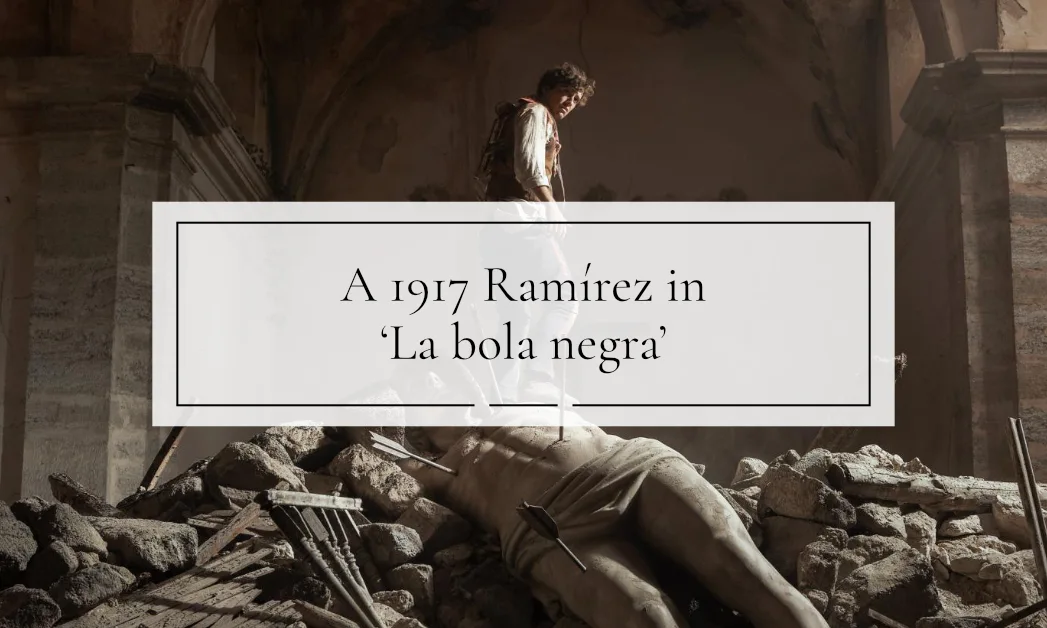
A 1917 “Viuda de Manuel Ramírez” guitar, part of the Guitarras Ramírez collection, appears in a scene of La bola negra, the film by Javier Calvo and Javier Ambrossi (Los Javis), alongside Raül Refree, a friend of the house and composer of the original score. An instrument born in the Madrid of the First World War, in the workshop of Filomena Vera, widow of Manuel Ramírez and the woman who kept the Ramírez tradition alive, thus travels to the big screen.
Updated: November 2026
In our Madrid workshop we are proud of our tradition and of preserving an important collection of guitars and archives. What does not happen every day is that one of them, more than a century old, ends up in front of a film camera. This is the story of how a 1917 guitar crossed paths with one of the Spanish films of the year, with a musician we admire and with a little-told chapter of our own family.
La bola negra: a film with Lorca in the background
La bola negra is the second feature film by Javier Calvo and Javier Ambrossi after La llamada. It draws on Federico García Lorca’s unfinished novel, which gives the film its title, and on Alberto Conejero’s play La piedra oscura, and follows three generations of men through decisive moments in the history of Spain.
Its journey has been dazzling. It premiered in the Official Selection in competition at the Cannes Film Festival, where, according to the press, it received a sixteen-minute standing ovation, and the Spanish Film Academy later chose it to represent Spain at the Oscars. The cast includes Guitarricadelafuente, Miguel Bernardeau, Penélope Cruz, Lola Dueñas and Glenn Close, among others.
That a film built on memory and on Lorca should feature cante and Spanish guitar is no coincidence. Lorca was also one of the great champions of cante jondo in the Spain of the 1920s, and the guitar is an inseparable part of that world.
Raül Refree: the guitar as a way of storytelling
The film’s original music is by Raül Refree, a musician and producer able to bring together tradition, experimentation and originality. His score combines woodwinds and brass with moments of great bareness, and the soundtrack album, released by Lakeshore Records, gathers more than twenty pieces.
The seguiriya of the brave
One of the most talked-about moments of the soundtrack is an original seguiriya in which the cantaora María Terremoto sings accompanied only by a Spanish guitar, in this case our 1917 Ramírez. Critics have noted how Refree recovers there the essence of what he had already done with Rosalía on Los Ángeles (2017): a strummed guitar and a voice, without adornment. It is proof that, when everything else falls away, a well-built and played guitar is still enough.
La nieve and other songs
Refree also co-writes, with Guitarricadelafuente, the song La nieve, submitted to compete for the Oscar for Best Original Song. It is a natural reunion: Refree produced La cantera, the singer’s first album, and Guitarricadelafuente makes his acting debut in the film. The soundtrack also includes the Polca de los desamparados, which Refree performs with Sabela Caamaño.
For those of us who want to go deeper into the album, the Rockdelux review (in Spanish) is a good starting point.
“Viuda de Manuel Ramírez”: the label of resistance and continuity
To understand the guitar that appears on screen, we have to go back to Manuel Ramírez (1864–1916), the younger brother and gifted pupil of our founder, José Ramírez I. Manuel opened his own workshop in Madrid and became luthier to the Real Conservatorio Superior de Música de Madrid. He trained three masters who would shape part of the 20th century, of a generation after José and Manuel himself: Santos Hernández, Domingo Esteso and Modesto Borreguero. It was also he who, in 1912, gave a young Andrés Segovia the guitar that is now kept at the Metropolitan Museum of Art in New York.
Manuel died on 25 February 1916 without children. What happened next is what gives our guitar its name: Filomena kept the workshop open, and the instruments that left it came to bear the label “Viuda de Manuel Ramírez” (“Widow of Manuel Ramírez”), because at the time it was frowned upon for a woman to work in this trade. Imagine what it meant to put her name on an instrument, and it was, besides, the only way she had to carry on. In doing so she kept on the craftsmen trained by her husband, who continued working there for some years, until each of them was able to become independent and open a workshop of his own. None of this would have been possible without Filomena’s courage and tenacity, and at Ramírez we stand up for her place in this story, unjustly hidden beneath the label “Viuda de Manuel Ramírez”, as if that were her only merit.
| Year | Milestone |
|---|---|
| 1864 | Manuel Ramírez is born in Alhama de Aragón. |
| 1882 | José Ramírez I opens his workshop in Madrid and trains his brother Manuel. |
| 1891 | Manuel becomes independent and opens his own workshop. |
| 1913 | Manuel hands over the famous 1912 guitar to Andrés Segovia. |
| 1916 | Manuel Ramírez dies; Filomena Vera carries on the workshop and the label “Viuda de Manuel Ramírez” is born. |
| 1917 | The year of the guitar that appears in La bola negra. |
| 1919–1924 | The craftsmen become independent and open their own workshops to develop their own templates and research. The last to leave is Modesto Borreguero. |
Note: the sources consulted differ on the exact dates each craftsman left. Here we follow the account of the Ramírez family, which places the opening of Domingo Esteso’s workshop between June 1919 and January 1920 and Borreguero’s departure in 1924.
A 1917 guitar: different hands, one workshop
This guitar is a unique testimony: it came from the same workbench where Manuel Ramírez trained Santos Hernández, Domingo Esteso and Modesto Borreguero, and it carries the imprint of a school whose crucible was the House of Ramírez, in Manuel’s workshop as much as in José’s.
There is also a curiosity of timing that we like: a guitar from 1917 was already twenty years old when Spain entered 1937, the year in which the film begins. Few objects can boast of having passed, intact, through so many decades of the history that La bola negra sets out to tell.
Ramírez and the cinema: a long-standing relationship
This is not the first time a guitar from our house has appeared on screen. We have already told on this blog how a Ramírez crossed the ocean to the Wild West of Bonanza, and the world of music has carried our name to stages, records and film sets for more than a century and a half. That it now does so alongside Raül Refree, a musician who understands the guitar as a place where tradition and experimentation both belong, fills us with pride.
If you would like to keep reading about the history and curiosities of the house, more stories await you on our Guitarras Ramírez blog.
Frequently asked questions
Which Guitarras Ramírez guitar appears in La bola negra?
A “Viuda de Manuel Ramírez” guitar from 1917, belonging to the Guitarras Ramírez collection, which appears in one of the scenes alongside Raül Refree.
What does “Viuda de Manuel Ramírez” mean?
It means “Widow of Manuel Ramírez”, the label carried by the instruments built in Manuel Ramírez’s workshop after his death in 1916, when Filomena Vera kept the business going until 1924, the year in which she possibly passed away.
Who is Raül Refree and what is his connection to the film?
He is the musician and producer who composed the original score of La bola negra. He has previously collaborated with Rosalía, Silvia Pérez Cruz and Niño de Elche, among many others, and is a friend of Guitarras Ramírez.
Who directed La bola negra?
It is directed by Javier Calvo and Javier Ambrossi (Los Javis), who wrote the screenplay together with Alberto Conejero, based on the unfinished novel by Federico García Lorca.
Do you own a guitar with a story? Every instrument holds a tale. If you would like to know our guitars better, ask a question or arrange an appointment with the workshop, write to us or book a video call. We would be delighted to help.